
The Introduction
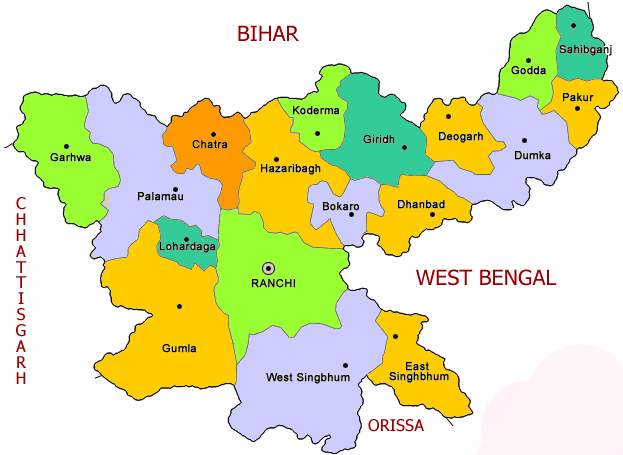
Jharkhand became the 28th state of Indian Republic on 15th November 2000 when the Indian parliament passed the Bihar Reorganization Bill which approved the creation of a new state consisting 18 districts from the southern part of Bihar and named it “Jharkhand”. Finally the people of the region got their demand of a separate state rewarded. In early 1990s, the famous Indian hockey captain and Olympian Jaipal Singh proposed the idea of a separate state by reorganizing the southern parts of united Bihar. Since, the movement continued over a century and many leaders involved and lead the crusade toward its destination.
History of Jharkhand
The history of the region is ancient. According to some historian and writers, a geographical region with distinguished culture called Jharkhand already exists in far history even before the great Magadha Empire. Famous historian Gautam Kumar Bera inscribed in his book “The Unrest Axle: Ethno-social Movements in Eastern India” that Jharkhand has been referred in Hindu epic Bhavishya Puran, the land where tribal ruled for thousands of years. Many scholars assume that there are cultural similarities between the tribes of Jharkhand and the Harappa people. For example, the languages used by the tribes here are identical to the languages used by Harappa people. The rock paintings are also similar. The legends of Jharkhand remained buried in darkness during the Vedic Age. Around 500 BCE, during the age of Mahajanpadas the entire Indian subcontinent was controlled by sixteen large states. In this era, the northern part of Jharkhand was a tributary to Magadha Empire and the southern part was a tributary to Kalinga Empire. Legends says in 13th century, Raja Jai Singh Deo of Orissa declared himself ruler of Jharkhand. Hence we can accept him as the first independent ruler of Jharkhand.
After the reign of Raja Jai Singh Deo, the province witnessed the rules of many local tribal heads and dictators. But sadly these dictators could not provide the people of Jharkhand neither fair governance nor welfare to them. The history of Jharkhand changed drastically after the rulers from Orissa marched with their armies, conquered the province and created states that were governed to provide welfare to its people with their involvement in governance. This ended the century long barbarism headed by the tribal dictators. The good tribal rulers continued their reign with welfare and good governance for rest of the time, known as Munda Rajas. They even exists now in some cities of Jharkhand.
During the Mughal period, the Jharkhand area was known as Kukara. After the year 1765, it came under the control of the British Empire and became formally known under its present title, “Jharkhand” – the Land of “Jungles” (forests) and “Jharis” (bushes). Located on Chhota Nagpur Plateau and Santhal Parganas, has evergreen forests, rolling hills and rocky plateaus with many places of keen beauty like Lodh Falls.
The colonization of the region is another significant period in the history of Jharkhand. In 1765, the province came under the control of British East India Company. The colonization led an instantaneous resistance by the local people. Tilka Manjhi, a Santhal leader from the Santhal belt of Jharkhand commanded the first revolt against the British government and local landlords, even hundred years before the Indian Rebellion of 1857. The British government sent their army and crushed down the uprisings of Tilka Manjhi. But the no contentment broke many revolt in several parts of the province. Later in 1779, the Bhumji tribes rose in arms against the British rule in Manbhum, now in West Bengal. Very soon it was followed by the Chero tribes’ unrest inn Palamau in 1800. The Munda tribes of Tamar region too rose in revolt in 1811 and 1813 followed by Hos’ revolt against British and landlords in Singhbhum in 1820. This is called the Lakra Kol Risings 1820–1821. Then came the great Kol Risings of 1832. This was the first biggest tribal revolt that greatly upset the British administration in Jharkhand. It was caused by an attempt by the Zamindars to oust the tribal peasants from their hereditary possessions. The Santhal rebellion broke out in 1855 under the leadership of two brothers Sidhu and Kanhu. They fought bitterly against the British troops but finally they too were crushed down. Other notable Adivasi warriors are Jabra Paharia, Veer Budhu Bhagat, Poto Sardar, Telenga Kharia, Phulo-Jhano, Manki Munda, Gaya Munda.
Then the Birsa Munda revolt broke out in 1895 and lasted till 1900. It was the longest and the greatest tribal revolt and also the last tribal revolt in Jharkhand. All these revolts were suppressed by the British government by heavy deployment of troops across the area.